You need to disclose AI content when it looks real enough that a viewer could take it for something that actually happened, or when it shows a real person, place or event doing something they did not. Obvious fantasy, animation and light cleanup usually do not need a label. If you generate your clips from prompts in a studio like Take4K, you already know exactly which assets are AI, so the work is deciding what to label, where, and in what words. This guide covers that for creators, marketers and small businesses.
In short
- Disclose when AI-made or AI-altered video or images are realistic enough to mislead: real people saying or doing things they did not, fabricated events or places, cloned voices.
- Clearly unrealistic content and minor edits such as color correction, captions and upscaling are generally exempt on major video platforms.
- Put the label where viewers see it first: the platform’s AI setting at upload, plus on-screen text or a caption close to the content.
- Use specific wording such as “AI-generated video” or “AI-modified” rather than vague phrases, and say which part used AI.
- A label never fixes a misleading claim. Disclose and keep the content honest.
What AI content disclosure means
AI content disclosure is telling people when and how AI generated or modified what they are looking at. That covers images, text, audio and video. Australia’s National AI Centre, in its November 2025 business guide, defines AI-generated content broadly as material created or modified, wholly or partly, by AI. That spans AI-assisted, AI-enhanced and fully AI-generated work.
That breadth is why the practical question is not “did I use AI?” but “would a viewer feel misled if they did not know?” Most disclosure rules are built around that second question.
A useful vocabulary:
- Fully generated: a clip or image created from a text prompt or a source image.
- Modified: real footage or a real photo changed by AI, for example a face swapped or a background replaced.
- Enhanced: real material cleaned up, sharpened or upscaled.
- Deepfake: in the European Commission’s Article 50 FAQ, AI-generated or manipulated image, audio or video that resembles existing people, objects, places or events and falsely appears authentic.
If you want a plain-language primer on how AI-generated content is defined and why it matters for publishing, this overview of AI-generated content is a good companion read.
When you should disclose
The major platforms converge on one test: realism that could mislead.
What YouTube asks you to disclose
YouTube’s help page says to disclose when AI-generated or altered content seems realistic. Its examples include:
- Real people appearing to say or do something they did not.
- Altered footage of real events or places.
- Realistic scenes that never occurred.
- AI-generated music that is the main focus of the video.
The same page exempts clearly unrealistic material and minor aesthetic edits, including beauty filters, color or lighting changes, captions, upscaling, repair and production assistance, as long as they do not mislead viewers about what happened.
What Vimeo asks you to disclose
Vimeo’s guidance requires labels for realistic generated or materially modified video. That includes fabricated depictions of real people, events or places, and cloned voices used in voiceovers. Obvious fantasy, animation and minor cosmetic or audio cleanup are exempt.
What advertisers are expected to do
For ads, the standard is consumer understanding. The IAB’s January 2026 framework is voluntary industry guidance, not an enforcement regime. It calls for consumer-facing disclosure when AI materially risks misleading a reasonable consumer about authenticity, identity or representation. The IAB’s August 2026 update describes a targeted approach meant to avoid both under-disclosure, which risks deception, and over-disclosure, which burdens advertising unnecessarily. It names synthetic images, videos, voices, avatars and human-simulating chatbots as possible triggers.
New Zealand’s Advertising Standards Authority takes a similar line in its guidance note on AI in advertising: disclosure is not expected for every AI-assisted ad, but should be considered where AI could materially affect how consumers understand authenticity, identity, products, events, endorsements or demonstrations.
A quick decision test
Ask three questions before you publish:
- Could a viewer believe this really happened? A photoreal street scene or a realistic presenter says yes. A cartoon dragon says no.
- Does it involve a real person, place or event? A real person’s likeness or voice raises the stakes sharply.
- Does it support a claim? If the clip demonstrates a product, an endorsement or a result, the AI involvement matters to the buyer.
Two or more yeses means label it. Australia’s National AI Centre frames this as a risk-and-contribution decision: the higher the impact and the more substantial or meaning-changing the AI use, the more visible, or the more numerous, your transparency measures should be.
Worked example
A small shop owner makes three clips for a spring campaign:
- A stylized animated mascot walking across a product shelf. Obviously unreal, so no label is required, though a caption mention costs nothing.
- A photoreal clip of a customer unboxing the product, entirely generated. Realistic and tied to a product demonstration, so label it “AI-generated video” on screen and in the platform setting.
- A real product video, upscaled to a higher resolution. This is a minor enhancement that does not change what happened, which is the kind of edit YouTube’s exemptions describe.
Three clips, three different answers, one test.
Where the label should go
A label nobody sees does nothing. Place it by following three habits.
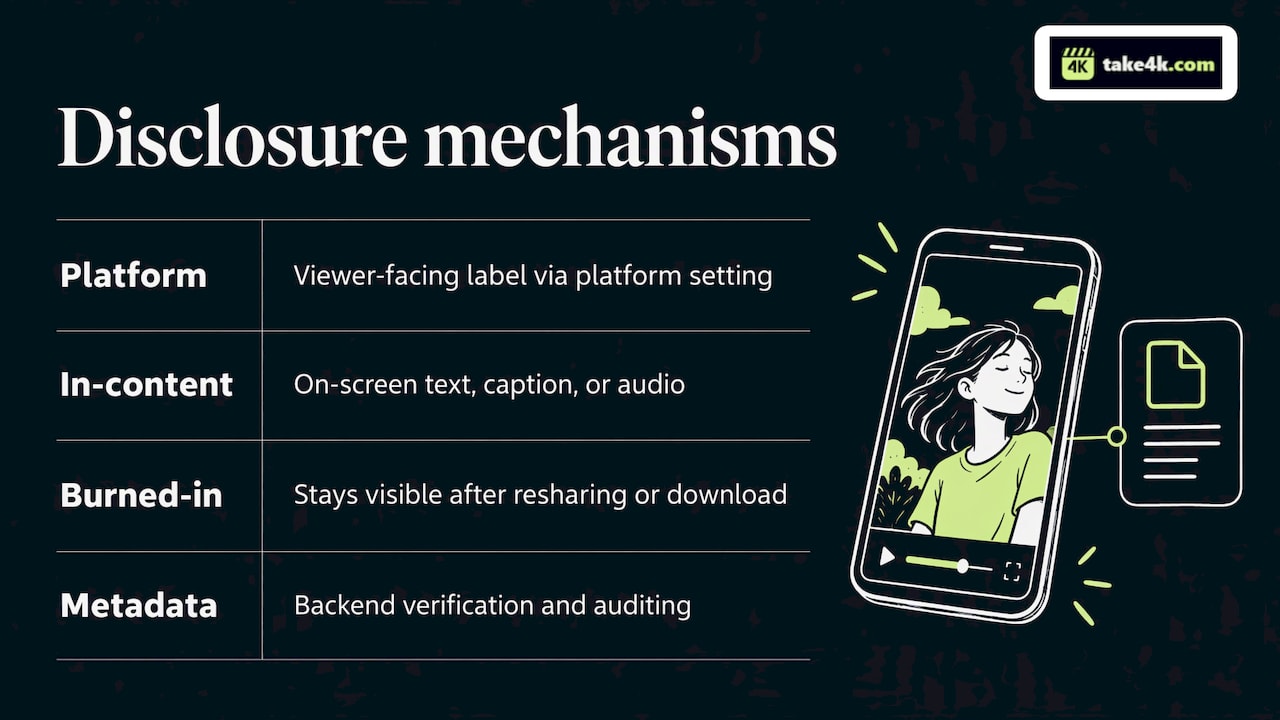
Use the platform’s own setting. On YouTube you disclose through the upload flow’s AI use setting, and YouTube then labels the video. The same page warns that failing to disclose consistently can lead to platform-applied labels, removal or suspension from the Partner Program. On Vimeo, the label appears on the video page beneath the title and in the embedded player, and Vimeo may apply a label you cannot remove, or take down seriously harmful content, when creators fail to disclose.
Add a disclosure in the content itself. The New Zealand ASA recommends clear, accessible disclosures close to the relevant ad content, using on-screen text, a caption, audio or another format likely to be noticed and understood. A short on-screen line in the first seconds, plus a caption or description line, covers most social and ad use.
Make it survive resharing. The European Commission’s guidance on EU icons for labelling AI-generated content says a label should be perceivable by first exposure and stay visible when content is reshared or downloaded. Burned-in text does this better than a description line that gets lost when a clip is reposted.
Behind the scenes, the IAB framework recommends machine-readable metadata on AI-involved advertising assets so they can be verified and audited. Under the EU’s Article 50 FAQ, machine-readable provenance alone does not satisfy the viewer-facing duty: people need to see a clear label too. Use both when the stakes are high.
Wording that works
Vague wording is the most common mistake. A 2025 CHI Extended Abstracts study, AI-Generated or AI-Modified?, found participants preferred “AI-modified” for changes involving a human and “AI-generated” or “AI-created” for fully AI-made content. Vague terms such as “AI Info” and “Made with AI” were less favored.
The New Zealand ASA’s examples are a good template: “AI-generated image,” “AI-generated video,” “AI-generated person,” “AI-generated voice” and “Image created using AI.” Australia’s guidance suggests labels like “generated by AI” or “created with AI assistance.”
Some ready-to-use lines:
| Situation | Suggested wording |
|---|---|
| Clip made entirely from a text prompt | AI-generated video |
| Still photo animated into a clip | Video created from a photo using AI |
| Real footage with an AI-replaced background | AI-modified video: background generated with AI |
| Photo animated with a synthetic voice | AI-generated voice and animation |
| Product ad scene built with AI | AI-generated scene. Product shown as sold |
The last column matters: the same CHI study found participants wanted the disclosure to say which parts of the content involved AI. “AI-generated background” tells viewers more than a blanket badge.
What your AI disclosure policy should contain
If you run a brand, a channel network or an agency, put the rules in writing so every editor applies them the same way. A workable policy, following the Australian guidance, has these parts:
- Scope: which content types are covered (video, images, voice, text) and who must follow it.
- Triggers: the realism and real-person tests above, plus any product demonstration or endorsement.
- Label standard: approved wording, placement (on screen, caption, platform setting) and minimum on-screen duration.
- Proportionality: low-risk, low-AI use gets a light label; high-impact, heavily AI-made work gets a visible label plus metadata or watermarking.
- Ownership: who checks each asset before publishing and who handles takedown or correction requests.
- Records: keep the prompt, the date and the export that went live so you can show what was AI-made.
The last point is easy when your generation tool shows every asset’s cost and type up front, because your project list becomes a natural log. Keep your own notes alongside it.
Local rules you should know about
US creators are mainly governed by platform rules and by general advertising honesty, and the IAB guidance is voluntary. But if your audience includes Europe or China, the picture is firmer.
- European Union: according to the Commission’s transparency guidelines, Article 50 of the AI Act applies from 2 August 2026. Providers must mark AI-generated or manipulated outputs in machine-readable form, and deployers must disclose specified deepfakes and some public-interest text. The text duty applies when AI-generated or manipulated text is published to inform the public without human review or editorial control. The guidelines also include exemptions and examples, including standard editing. The icons themselves are optional, while the underlying labeling duties are not.
- China: a summary of the 2025 measures says they took effect on 1 September 2025. They combine visible or audible labels with implicit metadata, and require users who post AI content to declare it and use platform labeling tools.
If you publish globally, build to the strictest rule you are likely to meet and your workflow stays simple.
Does labeling hurt trust?
The fear is that a label makes audiences scroll away. The evidence is more nuanced, and mostly reassuring.
- The CHI study found participants often viewed creator self-disclosure as more genuine than a platform-applied label.
- A 2025 Canadian report, Human or AI?, found small disclaimer labels did not significantly change perceived credibility or willingness to share in its tested posts.
- NIST’s synthetic content report says provenance and labels can contribute to trustworthiness but do not guarantee it, and warns that technical indicators can create false confidence if content is taken out of context.
The takeaway: label it yourself, label it specifically, and do not treat the label as a shield. EPIC’s 2024 analysis argues that clear, conspicuous disclosure supports viewer autonomy, but generic disclosures obscure which parts were generated and do not correct errors or bias. The New Zealand ASA adds that disclosure does not cure a misleading ad, for instance an AI-made before-and-after image implying results a product cannot deliver.
Common mistakes
- Burying the label in a long description while the video itself looks real.
- Using vague badges such as “Made with AI” when the viewer needs to know the voice or the scene is synthetic.
- Labeling the wrong thing: a disclosure on a harmless filter while a fabricated testimonial goes unmarked.
- Relying on metadata alone. It is invisible to viewers and can be stripped on reupload.
- Using disclosure to excuse a false claim. Fix the claim first.
- Labeling inconsistently, which is exactly what platforms say can trigger their own labels or penalties.
Making disclosure easy when you create with Take4K
Disclosure is simplest when you know your workflow. In Take4K you generate video and images from text prompts or source images, and you see the exact price of each asset before you create it. You only pay if the asset is delivered. Text-to-video starts from €0.19 per 5‑second video, so you can test several versions of a scene before choosing the one to publish.
That draft-first routine helps with labeling. Start with low-resolution drafts, decide which clip you will publish, and only then upscale it to Full HD or 4K. At that point you know which assets are fully generated, which started from a real photo, and which are just enhanced. Because upscaling is the kind of minor enhancement YouTube lists among its exemptions, a real clip you only upscale is a different case from a photoreal generated scene. Sort your assets into those buckets before you write a single label.
Take4K also lets you animate a photo into a talking clip with lip sync in several languages. A realistic talking person is exactly the case where an on-screen “AI-generated person” or “AI-generated voice” line earns its place.
Our perspective
Disclosure is not a tax on creativity. It is part of the finished product, like a credit line or a caption.
When we think about how people use an AI studio, we see two habits that make disclosure painless. The first is knowing what you made before you publish. Generating from a prompt or from your own image means you are never guessing whether a clip is synthetic. The second is working in stages: cheap drafts first, then upscaling only the version you choose. By the time you reach a final export, you have already decided what the piece is, and writing an honest label takes ten seconds.
Our view is simple. Use AI openly, label realistic work specifically, and let the quality of the result carry the audience. Seeing the price of each asset before you commit helps you try more ideas and keep only the ones you are proud to put your name on.
Vlad
Create it, then label it
If you are producing realistic clips for a channel, a campaign or a client, a studio that shows costs before you commit keeps the process predictable. Take4K text to video starts from €0.19 per 5‑second video, and image to video starts from the same price. The talking photo tool is priced at €0.34 to €1.08 per 5‑second video, and the video upscaler runs €0.07 to €2.33 per 5 seconds of video at 30 frames per second.

Plans are Starter at €11.99 per month (or €132 per year), Pro at €39.99 per month (or €439 per year), Max at €95 per month (or €999 per year) and Creator at €199.99 per month (or €2,189.88 per year). You can see the options on the Take4K home page.
FAQ
Do I have to disclose every piece of AI-assisted content?
No. Major platforms and advertising guidance focus on realistic content that could mislead. Clearly unrealistic material and minor edits such as color changes, captions or upscaling are generally exempt on YouTube and Vimeo. When in doubt, ask whether a viewer would feel misled.
What is the best wording for an AI label?
Be specific. Research favors “AI-generated” or “AI-created” for fully synthetic content and “AI-modified” where a person changed real material. Add the part that used AI, such as “AI-generated voice,” instead of a vague badge.
Where should the disclosure appear?
Use the platform’s AI setting at upload, then add a short on-screen line or caption near the content so it is seen at first exposure. Burned-in text survives resharing better than a description line.
Will disclosing AI use hurt my reach or credibility?
The research reviewed here points the other way for creators who label themselves: participants in the CHI study saw creator self-disclosure as more genuine than a platform label, and a Canadian study found small labels did not significantly change credibility in its tests.
Is there a law requiring AI disclosure in the US?
This guide relies on platform policies and voluntary industry guidance for US readers, such as the IAB framework. The EU’s Article 50 rules, applying from 2 August 2026, matter if you reach European audiences. For legal questions about a specific campaign, speak to a qualified attorney.
Sources
- Being clear about AI-generated content: A guide for business (Australian National AI Centre)
- Be clear about AI-generated content (National AI Centre)
- Transparency obligations under Article 50 of the AI Act (European Commission)
- Guidelines on transparency obligations (European Commission)
- EU icons for labelling AI-generated content
- YouTube Help: Disclosing use of GenAI content
- Vimeo Help: About disclosing videos as AI-generated or AI-enhanced
- New Zealand ASA: Guidance Note on AI use in advertising
- IAB AI Transparency and Disclosure Framework, January 2026
- IAB updated framework for AI transparency and disclosure, August 2026
- AI-Generated or AI-Modified? User Reactions to Labeling AI (CHI 2025)
- Human or AI? Evaluating labels on AI-generated social media content
- NIST: Reducing Risks Posed by Synthetic Content
- EPIC: Demystifying Generative AI Disclosures
- Labeling AI-Generated Content: China’s rules
- What is AI-generated content